
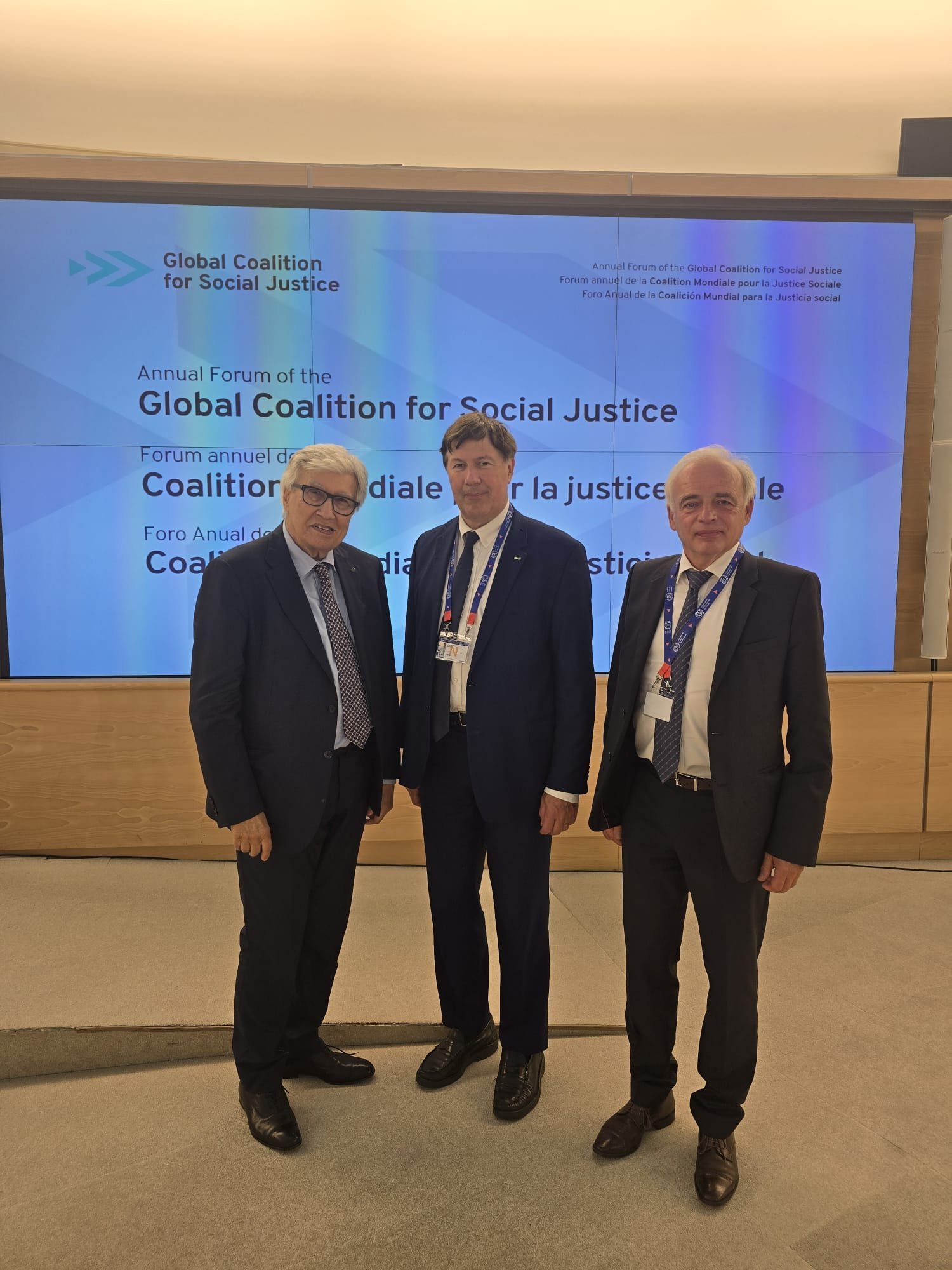


Gaëtano Stella and I, accompanied by Jean Ruwet (Belgium), we represented the World Union of Liberal Professions (UMPL) at the United Nations in Geneva on Thursday June 12.
We participated in the 113th session of the International Labor Conference on the Global Coalition for Social Justice, a global accelerator for employment. This annual Forum of the International Labor Organization (ILO) was a continuation of ongoing collaborative efforts, with Plenary Sessions and committee work.
In the morning, the main theme focused on decent wages: a driver of social and economic development.
In summary, the realities of each country must be taken into account. There are often too many rules and duties that prevent companies from moving forward. Work between governments and liberal professions is essential to reduce costs.
The United Nations wants to do more to overcome challenges and improve social justice.
Equal pay for men and women was discussed.
We are experiencing a demographic change, with an economic shift.
The ILO must bring together several sectors, including health.
Without health, there is no work.
The two essential sectors are education and health.
WHO and UNESCO would like to participate in these debates.
The ILO could manage a global platform, with a good methodology to move forward.
In conclusion to this theme, we need decent and living wages, to be indexed according to the cost of living.
We can no longer continue to have to work while remaining poor, hence the need for a minimum wage.
Finally, the world of work must be made more humane and fairer on an international level.
A call is made to us for concrete actions within a global coalition.
See you in a year to see the progress.
In the afternoon, the session focused on Responsible Business for inclusive and sustainable societies.
The responsibility of companies is their sustainability, with the imperatives linked to working with respect for human rights.
Here too, we note the importance of social justice.
Several countries from different continents shared their experiences with us in terms of social justice:
1. Switzerland : Confederation, with initiatives starting from the base, taking up environmental concerns. Switzerland has a national action plan. These approaches are managed with civil society, unions, private sectors and public authorities.
2. Botswana : Importance of human rights, in line with workers' rights. They have “rights guardians” to allow workers to “enjoy the place”.
Workers must know their rights. Companies often think about “sustainability” but rarely “social aspect”. Their unions must work while respecting the rights of workers, who fear intimidation from employers.
They must be taught to overcome this fear. 70% of workers are young people who are unaware of their fundamental rights. But watch out for an increase in the number of unemployed if they are victimized.
Botswana is a member of the ILO and the coalition.
It is essential to know the institutions that manage the money to know where it goes, how it is invested, as well as its return. The funds must treat workers well, who must know what was done with this money.
3. Malaysia : There is a Malaysian Employers' Federation. 85% of companies are SMEs, with a majority of micro-enterprises. Economic growth is 5%.
For each company with more than 20 workers, there should be a health and well-being specialist at work. Public funding is unclear.
If we invest in sustainable development, we have doubts. We must improve contracts within the framework of sustainable development and put sustainable financing where it is most needed. We often don't know where this money goes.
Also develop sustainable financing with a focus on pensions. Finance is a very powerful tool, but has positive or negative repercussions.
Decent work is sustainable and profitable in the long term.
In summary, how do we create patient money so that impatient money meets the standards?
An example is that a worker is interested in his bonus granted this year, not in the one he could receive in 20 years.
4. India : Progress must allow everyone to move forward. Investment is a very important lever, but it must adapt.
It benefits from very productive and developed industries. IT has created many jobs, AI will create more, it will be beneficial if it is mastered.
The goal of the world must be world progress. Work allows the creation of well-being. A worker needs social status to save with peace of mind.
There is a free trade agreement between India and Switzerland.
5. Ukraine : Switzerland hopes to rebuild it. There is development cooperation spread over 12 years, which is stronger than humanitarian aid.
Ukraine benefits from subsidies and support from Swiss companies. One day Ukraine will be a big, prosperous market.
In conclusion, responsible businesses are the foundation of an inclusive society and social dialogue must continue in this direction.
To finish, we are introduced to the Swiss firm Nestlé, which is an example of consistent business conduct.
There we find the complexity of the size that agri-food companies most often have.
Nestlé has 270,000 employees, it is a large multinational.
The agri-food industry is mainly concerned at the farm level.
There are many challenges, with a duty of vigilance on human rights, forced labor and child labor.
Fourteen coffee and cocoa supply chains work with Swiss companies.
There are internal action plans aimed at creating a favorable environment in favor of human rights.
Compliance of the base is ensured by a steering committee and a steering committee, associated with numerous managers in each market.
Nestlé works with many stakeholders, aiming to move forward to ensure a better sustainable business environment.
Bernard Jacquemin
Vice-president of UMPL